That new YouTube Channel is called "The Culture of The High Country" and is operated by Alton Medlin as the interviewer and Jason DeWitt, as the videographer. The Channel is filled with Ride Abouts that include outrageous country banter between two fossilized old local men as well as including some killer interviews with some very interesting and important people.
We feel that we have cracked the "AI Curtain". Your participation with checking us out and leaving comments.
The format of our videos is:
An introduction establishing we are on another Ride About, the banter being southerly humorous.
The interview lasting from five minutes to thirty minutes.
The post interview sum-up and more southern banter.
We have plenty of possibilities for future interviews because we know lots of people from the High Country of western North Carolina, and we know them very well.
HOWEVER: We are actively seeking ideas for future videos. If you know someone who is:
Ether old enough to be a good historian of their local events
Or is someone who has or has had a very cool job.
Sometimes there are positions held in life where most people assumed there must be someone holding such a position, but noone knows who that person is; this is where we come into play. We strive to interview such unique people
Give us a call at828-413-2482 or email us at: This email address is being protected from spambots. You need JavaScript enabled to view it.
Our Doumentary Series feature Alton & Jason's Ride-About interviews with poeple who have very cool jobs.
If you ever find yourself wandering through Avery County, North Carolina on a lazy Sunday afternoon, do yourself a favor: pull over at the historic Pineola Inn. Follow the rich, flying notes of a fiddle, and you will find Alan Johnson sawing away on his fiddle for a captivated crowd.
Alan might just be the busiest musician in the entire High Country. In fact, if you ask him exactly how many bands he currently plays in, he will look at you, smile, and give you a perfectly honest answer: "I don't know."
When we sat down to chat with this local legend, we quickly realized that Alan’s deep musical roots stretch far beyond our mountain ridges. He carries with him a lifetime of stories, including a remarkable connection to Music City royalty.
A House Filled with Sound
Music was a family affair for Alan from the very beginning.
"I had a brother ten years older who wanted to play rock and roll, and a daddy who played the fiddle," Alan reminisces. "So growing up, there was every kind of music in the house. I picked up the fiddle around age nine and have never really put it down."
That early, eclectic exposure paid off. Today, you can catch Alan sharing his gift across the region with the David Wiseman Band, the Johnson Brothers, and Woody and the String Band. But before becoming a staple of the local mountain music scene, Alan took a leap of faith that led him straight to Tennessee.
Mastering the "Nashville Handshake"
At age 29, Alan packed his bags and moved to Nashville, driven by a dream and a fiddle case. Like many aspiring artists, he quickly learned the hustle of the town.
"I handed out my card left and right," Alan says with a grin. "They called it the 'Nashville handshake.' That's when you shake a person's hand and palm them your card."
The music industry is notoriously tough to crack, and the silence can be deafening. For six months, Alan’s phone didn't ring. "I promise you, I was about ready to pack it in and come home," he admits.
But destiny had other plans, and it arrived in the form of a legendary mentor.
An Unexpected Call from John Hartford
Unbeknownst to Alan, he had an incredibly powerful ally in his corner: John Hartford, the brilliant, Grammy-winning songwriter behind the masterpiece Gentle on My Mind.
"He befriended me when I first arrived in Nashville," Alan shares. "Almost exactly six months to the day I arrived, the phone rang, and it was Hartford."
Hartford wasn't calling with a gig; he was calling to check on Alan's spirit and make sure the young musician hadn't given up on his dream. That single, encouraging phone call shifted the universe. Within a single week, Alan booked three gigs—and the rest was history.
Some of Alan’s fondest memories of those years aren't from the big stages, but from the quiet moments. He smiles warmly recalling how he and Hartford would sit together for hours inside Hartford's home, trading tunes and playing their fiddles simply for the pure joy of the music.
The Gift of Ear
Despite his success and undeniable reputation, Alan remains incredibly humble about his craft.
"I am not the greatest fiddle player in the world," Alan insists. "Those guys sit and practice all day long, the way a golfer hits a thousand practice balls a day. That's just not me."
What Alan lacks in rigid practice routines, he more than makes up for with a rare, innate genius. Growing up, if he heard a complex lick played by one of his musical heroes—like bluegrass icon Doyle Lawson—he didn't need sheet music or a lesson. He could instantly play it back, perfectly, note for note.
It is that raw, authentic talent that makes Alan’s music so magnetic. He isn't just playing notes; he is channeling a lifetime of heritage, grit, and passion into every stroke of his bow.
Next time you are in Pineola on a Sunday, pull up a chair, grab a cold drink, and listen to a master at work. Just don't forget to offer him a handshake
The David Wiseman Band
The David Wiseman Band, Kin to Scotty & LuLu Belle Wiseman, famous bluegrass song writers; Alton & Jason's Ride About documentary series. In western North Carolina as well as in the Bluegrass music genre know the names of Scotty & Lulu Belle Wiseman who wrote dozens of number 1 songs. David Wiseman has recruited Alan Johnsonm the fiddle player extraordinaire.
Travis Proctor is a very cool woodworker with a Wood Shop
Alton & Jason's Culture of the High Country Interviews Travis Proctor is a very cool woodworker with his Wood Shop; featuring chicken egg farming, potato &, apple farming, raspberry picking, bee keeping and other skills that allow Travis to live off the land.
Sam, General Manager Apple Orchard at Altapass, Spruce Pine, Blue Ridge Parkway
The Apple Orchard At Altapass, an historic landmark dedicated to demonstrating Appalachian culture. There are hayrides that explore the apple trees. Live music from local musicians show the instruments used when playing Bluegrass Music as a Jew's Harp. Come to the Apple Orchard and enjoy being entertained as you work on a second retirement.
Jerry Moody Agricultural Extention Service
Rooted in Avery County: How Jerry Moody Keeps the Blue Ridge Growing
When Ken Walters suggested that Jason and I document the work of Jerry Moody and his staff at the Avery County Cooperative Extension Office, my mind immediately flashed back to my failed tomato crops. (Though, to be fair, calling two lonely tomato plants a "crop" is a stretch).
“Ken,” I joked, “all the green bled out of my thumb years ago. I don't think Jerry can help me.”
But as we sat down with Jerry, we quickly realized that his expertise goes far beyond backyard gardening. Jerry is a man with a massive number of irons in the fire. In fact, he might just be the busiest person in the Blue Ridge Mountains.
The Christmas Tree Capital (and Beyond)
For more than a century, Avery County built its reputation on apples, cabbages, potatoes, and ornamental shrubs. That shifted in the 1960s when the agricultural economy fell in love with the Fraser Fir.
Today, North Carolina produces roughly 25 percent of the nation's annual Christmas trees, and Avery County farmers alone cultivate close to a million of them. But don't let the holiday statistics overshadow the rest of the landscape. The county still thrives on its traditional crops, and Jerry leads a dedicated team of agents and technicians who keep all of these diverse agricultural programs running smoothly.
Preserving History and Supporting Community
The scope of the extension office’s work is incredibly broad. Here are just two powerful examples of how Jerry’s team impacts the community:
Saving Heirloom Apples:
The staff maintains a living germplasm collection of rare heirloom apple varieties. If a local grower wants to plant a "Red Sheep Nose" or a "Summer Banana" apple a few years from now, they can simply take a graft from one of the county’s preserved trees to start their own.
Empowering Local Youth:
For local children who need a safe, enriching environment to learn and play during the summer, the office coordinates nine weeks of a dynamic 4-H Day Camp known as WOW.
From preserving agricultural history to investing in the next generation, Jerry and his team are the quiet engine driving Avery County forward.
Rooted in Avery County: How Jerry Moody Keeps the Blue Ridge Growing
When Ken Walters suggested that Jason and I document the work of Jerry Moody and his staff at the Avery County Cooperative Extension Office, my mind immediately flashed back to my failed tomato crops. (Though, to be fair, calling two lonely tomato plants a "crop" is a stretch).
“Ken,” I joked, “all the green bled out of my thumb years ago. I don't think Jerry can help me.”
But as we sat down with Jerry, we quickly realized that his expertise goes far beyond backyard gardening. Jerry is a man with a massive number of irons in the fire. In fact, he might just be the busiest person in the Blue Ridge Mountains.
The Christmas Tree Capital (and Beyond)
For more than a century, Avery County built its reputation on apples, cabbages, potatoes, and ornamental shrubs. That shifted in the 1960s when the agricultural economy fell in love with the Fraser Fir.
Today, North Carolina produces roughly 25 percent of the nation's annual Christmas trees, and Avery County farmers alone cultivate close to a million of them. But don't let the holiday statistics overshadow the rest of the landscape. The county still thrives on its traditional crops, and Jerry leads a dedicated team of agents and technicians who keep all of these diverse agricultural programs running smoothly.
Kenny Lindahl Storyteller Plus, Is The Yankee Who Cracked the Carolina BBQ Code (And Built a Smoker Bigger Than Your Truck)
If you grew up in Western North Carolina, you know our barbecue rules are sacred. You also know that anyone born north of the Mason-Dixon line trying to cook a pig is usually a recipe for disaster.
Enter Kenny Lindahl: Allentown, Pennsylvania native, motorcycle enthusiast, and the undisputed barbecue hero of the High Country. You can see this absolute madman and his legendary rig in action right here on Kenny's YouTube Video.
A Pennsylvania Boy Gets Dragged Down-East
Kenny spent his youth in commercial kitchens up north, but his real education started 25 years ago. That is when he married a girl from Whiteville, moved to traditional down-east country, and opened a restaurant.
Now, if you know anything about a coastal family reunion, you know it is legally mandatory to have a whole smoked pig waiting on a grill. If that pig hasn't been basted all night in a vinegar-and-pepper sauce until your eyes water, it’s not a reunion—it’s a crisis. Kenny quickly realized that if he wanted to survive his new in-laws, he had to master the art of the traditional low-and-slow smoke.
Running a restaurant is a brutal way to make a living. Whenever Kenny needed to clear his head, he’d jump on his motorcycle, ride up into the High Country, and hide out at the Pineola Inn. Eventually, the mountains called him home for good, and he brought his hard-earned BBQ wizardry with him.
The Double-Barrel Pig Chariot
You can’t roll into the High Country claiming you know pork without the hardware to back it up. Kenny’s smoker is an absolute unit. Most locals have seen plenty of pig cookers, but Kenny’s rig looks like it was engineered by NASA for maximum pork output.
This beast comfortably fits two entire hogs and features a mad-scientist design:
Dual Firebox Doors: Placed on opposite sides for ultimate access.
Twin Smokestacks: Drafts the air perfectly across the meat.
Zero Cold Spots: Because uneven cooking is a sin.
Kenny’s Laws of Smoke: Don't Kill the Pig Twice
The secret to Kenny's barbecue isn't just the vinegar; it is absolute, obsessive control over the temperature. He has one golden rule for anyone trying to cook a pig at home, and you should probably write it down:
The Two-Hour Window: The first two to three hours are strictly for flavor and smoke.
The Hard Drop: After that, back off the wood and drop the pit to a slow, low 225 degrees.
The Lock: Hold it right there until it’s done.
The Rookie Mistake: Do not keep feeding wood the whole time. If you over-smoke the meat, you turn it bitter, kill the flavor, and disrespect the animal.
In a documentary of Alton & Jason's Ride About series, we interviewed Keith Harris, an honest-to-God American "Sea Hunt" marine biologist. Keith Harris talks about his education and training (all done in North Carolina) and about some more memorable moments of his career. Keith has experience with being a deckhand to coordinating fish tanks for three government-owned marinas on the Carolina coast. Near the end of the video, Keith talks about clearing channels for submarines for the Navy and how to proceed with minimal damage.
Avery Riverwalk Quilting Guild
Stitching the Truth: Our Quest for the Ultimate Quilt Pattern
Every great road trip starts with a friendly argument. For Jason and me, it was a genuine dispute about quilt history. Having spent years in the antique business selling vintage textiles, I know good and well which quilt pattern folks ask for the most. But, of course, Jason didn’t believe me.
Our quest took us straight to the Avery Riverwalk Quilting Guild. Walking into that space, I knew instantly we were surrounded by immense talent—my own wife used to be a guild quilter, so I recognize the real deal when I see it.
Our primary contact was Cindy, and let me tell you, that woman is a little ball of fire. When Cindy pours her energy into a project, the results are first-class every time. She can run a local raffle you'd figure might raise two or three hundred dollars, and doggone if she doesn't pull in two thousand instead.
Right after we walked in, I thought one of the ladies was actually wearing a full bed quilt. When she stood up, it turned out to be a uniquely styled pair of quilted overalls! She confessed she didn't make them herself—but proudly declared she sure could have, if she just decided to put her mind to it.
Samplers, Wonky Stars, and a Bit of State Pride
Another talented member, Karen, gave us the grand tour of their latest creations:
The Patriotic Sampler: Karen walked us past a stunning display where every single block was entirely different, yet perfectly balanced to create a cohesive masterpiece. Check out our latest video to see how these individual patterns blended together.
The Ohio Star: I practically had to cover my eyes when she pointed this one out. Come on, Karen! North Carolina has its own quilting star!
The "Wonky Star": She showed us a pattern set on a sharp angle. It turns out "wonky star" is an actual, official industry term. Who knew?
The New Christian Church Wall Hanging: We also got a look at a beautiful custom wall hanging the guild created and presented to the church as a thank-you for hosting their meetings every month.
How Quilting Has Evolved (But the Gossip Stays the Same)
Karen also caught us up on how the craft has changed over the generations. In the old days—long before Jason's or my grandparents were around—women would gather around a massive wooden frame with needle and thread. They would bring food, talk all day, and stitch a quilt entirely by hand.
The Avery Guild keeps that beautiful tradition alive, just with a modern twist. Members meet up at ten in the morning, run an educational program, share a massive potluck lunch, and spend the afternoon sewing on advanced, programmable machines.
And as for all the talking and neighborhood gossip during those sewing hours? This old boy knows better than to say anything about that!
3,000 Years of Cozy History
Here is a quick fact our ride-about partners might not know: humans have been quilting for over 3,000 years. It is an art form built to last. In fact, we have quilts in our own home that my wife's mother made sixty years ago, and they kept us perfectly warm against the elements again just this past winter.
But let's get back to the real reason we drove all the way to Avery County. We went to find out, once and for all, which quilt pattern reigns supreme. One of us walked away entirely right, and the other was proven dead wrong.
I’m not going to spoil the big reveal here—you’ll have to watch the video to see who takes home the bragging rights!
Jesse Smith Blind Musician holding guitar at a microphone
Storyteller Jesse Smith leads the Crossnore Jammers
The Crossnore Jam is in Crossnore Communities for Children (North Carolina), coming from a prominent local family with deep medical and educational roots in the mountain community.
Despite being legally blind from Retinitis Pigmentosa, he is a dedicated community leader, former town mayor, musician, and outdoor enthusiast.
Family and Community Roots
Medical Legacy:
His great-aunt and uncle (Dr. Henry and Mary Martin Sloop) founded the Crossnore School and brought early healthcare to the area, while his father, Dr. E. H. Smith, practiced medicine in Crossnore for over 54 years.
Local Service:
Jesse served the town as a council member and mayor.
Musical Leadership
The Crossnore Jam: He took over leading the monthly community jam sessions at the town's Meeting House after the previous leader moved away.
Open to All: The lively gatherings welcome anyone to bring an instrument or just listen and enjoy the fellowship.
Maggie Lauterer, Historian, "The Singing Pastor"
Step Inside the Story With Maggie Lauterer Want to see the restoration firsthand?Watch the video hereto step inside their historic cabin, discover the full journey of how it was moved, and catch a rare moment of Zack playing the banjo. Some places you simply visit, but this is a home that draws you in and makes you want to stay.
Finding Home: How an Asheville News Anchor Rescued a Forgotten Log Cabin
As a child, Maggie Palmer spent her summers under the shade trees of her grandfather’s cow pasture in Avery County. She and her cousins swung from long vines, playing Tarzan and Jane, tag, and hide-and-seek. Amid the laughter, Maggie made a silent promise to herself: one day, she would build a home and live in this pasture forever.
As she grew older, that dream evolved. While driving the back roads of Western North Carolina to help her grandmother locate an old log cabin for historical restoration, a new vision took shape. Maggie decided she would rescue a deteriorating log cabin, move it to her grandfather’s pasture, and make it her permanent home. Later, when her grandmother gifted her a handful of flower seeds, the final piece of the puzzle fell into place. Maggie now dreamed of a historic log home surrounded by a vibrant, self-planted flower garden.
A Detour from the Mountains
Life, however, had other plans. Following high school, Maggie left the mountains to attend UNC. Marriage, a family, and a busy career in journalism followed. She worked in the newspaper business across Rutherfordton and McDowell Counties before becoming a reporter for the Asheville Times. Eventually, she became a familiar face across Western North Carolina as a news anchor for WLOS Channel 13 in Asheville.
A Bequest and a Second Chance
Decades later, following the passing of her mother, Maggie inherited eleven acres of mountain land. To her amazement, the acreage included the exact cow pasture from her childhood.
As retirement approached, her childhood dreams came roaring back. However, she faced a major obstacle: most of the authentic, historic log cabins in Western North Carolina had already vanished.
The Hidden Cabin
Like all great stories, fate stepped in. While attending a Palmer family reunion in Cleveland County, her cousin Jim grabbed her by the arm. “Come with me,” he said." Jim led her off the main road to a hidden, rapidly deteriorating log cabin. The owner, a relative living in Pennsylvania, had no interest in saving it. Jim turned to her and said, “Maggie, nobody wants it. You’re the only one I know who can save it.”
Walking Onto a Magazine Cover
Today, that rescued cabin stands proudly in Grandfather Dellinger’s cow pasture, enveloped by a sea of blossoms. It is home to Maggie and her husband of forty years, Zack Allen. Driving through the dense woods toward their property, the anticipation builds until you clear the tree line. As my companion Jason remarked on our drive up, “When you reach the end of that driveway, the whole scene looks like it walked straight off the cover of Country Living magazine.”
The transformation was a monumental labor of love. About thirty years ago, Maggie and Zack transported the cabin up into the mountains, cleared a flat clearing, and bulldozed the foundation. Every corner of the homestead carries a piece of history. Their kitchen, for instance, is housed in a separate, historic outbuilding that once stored her great-grandfather’s thresher and seed corn.
A Living Landscape of Memories
The breathtaking grounds are entirely Maggie's own creation. Two decades ago, her cousin John showed up on the Fourth of July to help dig and landscape a beautiful fish and lily pond right outside the front door.
But it is the vibrant daylilies that hold the deepest emotional weight.
“The daylilies,” Maggie explains, “came from Mr. Weatherman over in Spruce Pine, a man who went to school with my father. He planted and tended a hillside of them in remembrance of his wife until he died at age 100.”
Standing in her yard among the endless blooms, Maggie smiles and says, “I want to be just like Mr. Weatherman.” Watching her surrounded by the paradise she built from a childhood dream, you believe her completely.
Mary Morgan, Bee Keeper
Storyteller Mary Morgan Tells About Her Bees
The Secret Life of Bees: Why These Buzzing Bundles of Energy Matter More Than You Think
If all the bees disappeared, mankind would have just four years to live. While many people attribute this ominous quote to Albert Einstein, its true origin remains a mystery. Fact or fiction, one thing is certain: our survival is deeply intertwined with these tiny pollinators.
If your neighbor calls to warn you about "drones" buzzing over your yard, don't panic. You are not being spied on, and you are definitely not getting bombed.
Those drones are actually male honeybees on a very specific mission: hunting for a virgin queen. You can leave your fly swatter inside because you face zero danger of getting stung. Swarming male honeybees have exactly one purpose in life, and nature did not equip them with a stinger to do it.
A Numbers Game Too Big to Picture
Mary is just one of roughly 125,000 beekeepers across the United States. The vast majority of these individuals are dedicated hobbyists rather than commercial farmers.
Yet, their collective impact is staggering:
2.6 million managed honey-producing colonies exist nationwide.
60,000 bees can live in a single colony at the height of summer.
100 billion bees make up the estimated national population.
Because counting one hundred billion buzzing bugs is impossible, beekeepers measure their success by tracking colonies instead of individual bees.
Winter Survival and the Ultimate Cliffhanger
Beekeeping is not for the faint of heart. Two massive challenges threaten hives every year: bitter cold weather and hungry predators. Mice, raccoons, deer, and bears all love the sweet taste of honey.
When you combine freezing temperatures with determined wildlife, many beekeepers lose up to half of their colonies every single winter.
But Mary is a fighter. She has mastered the art of keeping creatures big and small from robbing her hives. However, winter always tests a beekeeper's limits. During the recent brutal winter—where temperatures plummeted to a bone-chilling five degrees—how did her hives hold up? How many of her bees actually froze to death?
The Recipe for a Single Jar of Honey
To truly appreciate a bee's work ethic, look at a single worker bee. In her entire lifetime, she will produce just one-twelfth of a teaspoon of honey.
To fill just one single, one-pound jar of golden honey, an army of bees must execute an unbelievable logistical feat.
After stealing pollen from millions of blossoms and flying a distance equal to twice around the globe, the bees must still engage in a massive collective wing-flapping process to evaporate the moisture and create that sweet, semi-liquid gold.
Next time you drizzle honey onto your toast, remember the tiny miracle workers who flew across the world to make it happen.
Stinky Honey and Shake a Tail Feather
Mary also has a burning question for our ride-about partners: "Has anybody ever tried stinky honey?" If you have, drop us a comment below! But come on now, Mary—what kind of question is that, and is stinky honey even a real thing? Let's change the subject.
I need to level with you: the thought of sixty thousand bees buzzing and swarming around gives me the absolute heebie-jeebies. But when I think of Ray Charles and the Blues Brothers singing "Shake a Tail Feather," now that is cool.
Here is the connection: some beekeepers swear those famous dance moves were actually inspired by watching honeybees get their waggle on. Truth or fiction? I know not.
The Modern-Day Pioneer and Storyteller: How This Mountain Man Lives Off the Grid for $40 a Week
Travis Proctor has been leading the life of a pioneer. Pull off the Blue Ridge Parkway, turn down a winding gravel road, and you will step straight into a time capsule. Nestled deep in the Appalachian wilderness sits a hand-built log cabin. If you woke up on its front porch, you would swear you had been transported back to the year 1750. This is the home of Travis Proctor, a modern-day mountain man who has spent forty years mastering the art of self-sufficiency.
Travis lives on eleven serene acres tucked tightly between the parkway and a protected national forest. It is a place of absolute peace where neighbors will never encroach. Here, Travis has created a blueprint for sustainable living that bridges history with the modern world.
Living Abundantly Off the Land
Living off the grid does not mean living in scarcity. For Travis, the land provides a rich daily bounty:
1) Hunting and Fishing: He hunts wild game for meat and fishes for fresh trout in his three private ponds.
2) Fresh Breakfast Daily: He raises chickens as pets, and they return the favor by delivering fresh eggs every morning.
3) Orchards and Foraging: His property boasts flourishing apple trees and tons of vibrant raspberry bushes.
Because the land is so generous, Travis only visits the grocery store occasionally—spending a mere $40 a week on supplementary staples.
Building a Sanctuary from Scratch
Travis’s cabin began as a simple kit. He watched a crane hoist the heavy perimeter logs into place, but everything after that was pure grit and personal craftsmanship.
To bring his vision to life, Travis lived in the basement for two years. During that time, he single-handedly wired the entire home, completed the plumbing, and hand-chinked the spaces between every log. Over the decades, he has continuously improved the structure and filled it with a curated collection of historical artifacts.
Pioneer Technology in the Modern Era
In a recent video tour, Travis shared the low-tech, high-efficiency systems that keep his homestead running smoothly without a massive carbon footprint.
The Natural Refrigerator
He dug a traditional root cellar deep back into the earth. Root cellars act as natural refrigerators, maintaining a temperature that stays ten degrees cooler than the ambient outside air. This is exactly how early pioneers survived harsh winters. In this cellar, Travis keeps potatoes and apples perfectly crisp and edible right up until spring planting.
The Apple Cider Press
Travis also demonstrated his vintage-style apple cider press. The process is beautifully simple: load the fresh apples into the top hopper, turn the gears to crush them into a fine pulp, and collect the mash in a cloth sack. A heavy manual press then squeezes out pure, sweet, golden cider.
A Paradise for History Buffs and Hikers
For those who yearn for serene surroundings, Travis’s homestead is the ultimate inspiration. But for history and adventure lovers, the real magic lies just beyond his front porch.
Travis gladly guides visitors through ten miles of pure, untouched wilderness down Lost Cove Creek. There are no roads leading into this gorge. Once you step onto the trail, there is no turning back—your only option is to hike your way through history.
Travis Proctor is living proof that the pioneer spirit is alive and well. By looking to the past, he has built a peaceful, independent future.
At the edge of the town of Crossnore, North Carolina, tucked into one of those tight mountain curves that scares the heebie-jeebies out of the outlanders, sits Jennifer Pinter's specialty dessert shop.
"When we opened the shop twenty years ago, all the locals laughed at us," Jennifer recalls with a smile. "Nothing had ever made a go of it in this curve, but I think that curve was a blessing for this place."
It is hard to argue with her logic. The curve becomes so sharp so quickly that drivers find themselves slowed down almost to a complete stop. That is the exact moment you start wondering if you have accidentally driven straight through a time tunnel. Sitting directly in front of you is the Linville River Mercantile and Bakery, and it practically beckons you to pull over.
Oh, That 1920's Look Inside
I must confess: the first time I pulled into Jennifer's parking lot, it was a foggy afternoon, and walking through the front doors actually spooked me a bit. The interior looked so authentically like 1929 that I half expected Rod Serling to step out from the back room to say, "Welcome to the Twilight Zone." Thankfully, the rich aroma of freshly baked goods quickly sent those eerie thoughts scampering away.
The Magic is with Baking the World's Best Stuff
Jennifer isn't just a talented baker; she is a designer, a passionate collector, and a woman who has spent over thirty years cultivating her unique sources. The entire space is intentionally crafted to make you forget the modern constraints of today's fast-paced lifestyle. If you have a deep love for history and antiques, you will easily feel like pitching a tent just to camp out inside her store.
And The Icecream is to Die For
During our visit, I sat down at a turn-of-the-century round oak ice cream table, resting just four feet from a vintage 1920s soda counter. Looking at a stacked row of fluted ice cream sundae dishes, my mouth immediately started watering.
Some People Act Like Most Animals When They See Themselves in a Mirror
I was just about to place my order when I noticed a short hallway nearby that ended in a full wall of mirrors. Intrigued, I pointed toward it and asked Jennifer, "Does anybody ever think that hall is twice as long and accidentally run into themselves?" Jennifer grinned instantly. "Actually, one day a woman went down that hall and politely excused herself to the oncoming lady. When she got no answer from her own reflection, she came right back out and told me she’d just met the rudest woman in Avery County!"
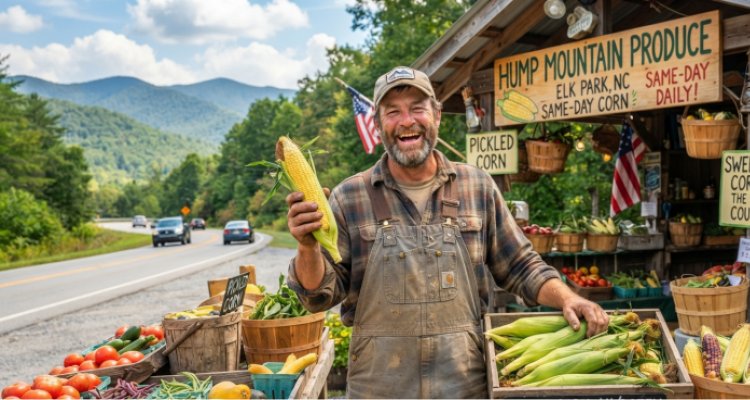
StorytellerBrian does things just like his uncle, his great-uncle, and his dad did. In fact, Brian is well schooled in the art of peddling; his school bus dropped him off at his uncle’s roadside stand for advanced experience in peddling produce. Today, Brian farms and operates a produce market inside this brick building at the base of Hump Mountain located above Elk Park, NC itself. Since the year 2011, Brian has been making a comfortable living giving below-market prices to his customers.
Should you step inside his produce fortress and you will find shelves packed with blue-ribbon pickled creations that the big corporate grocery chains couldn't dare to consider stocking. And yes, that includes pickled corn. We have to ask why should cucumbers have all the fun? All our jarred goods are born in a state-certified kitchen. You know you are getting produce earning pure Appalachian gold medals; this is not a science experiment.
“Farming up here in the High Country is a brutal gig,” Brian admits. “The soil refuses to wake up until it hits a cozy sixty degrees. And just when you think you're safe, a rogue late frost swoops in to murder your crops, forcing you to start the whole agonizing process all over again.”
To understand how we got here, we have to travel back to around 1950, when Alton’s family decided to brave a road trip into the mountains. Mountain driving back then wasn't for the faint of heart. The roads didn't just curve; they twisted like an angry snake. We are talking about old-school hairpin turns so violent you could literally wave at your own taillights as you rounded the bend. Throw in a total lack of guardrails, and drivers were forced to crawl along at a snail's pace. Local farmers, spotting a captive audience of road weary motorists, wisely set up shop at the few safe pull-offs. They calmed rattled nerves with fresh veggies, warm apple pies, jars of jelly, and mountains of harvest corn.
Now, despite a lifetime of eating their way through local spots, Alton and Jason had never achieved the holy grail of agriculture. Thus "Same Day Corn". For the uninitiated, that means the corn was still hanging on the stalk that morning. When word leaked that Brian was staging a corn-pulling raid the next day, our production crew showed up at the crack of dawn to hijack thirty-six ears of that special gold. A porch party was immediately assembled, friends were handed ears to shuck, the grill was fired up, and everyone finally learned what real, ultra-fresh mountain corn tasted like.
Like Us. Subscribe. Pass It Forward
Storyteller Matthew Hitechew is the Dean of Arts & Sciences at Mayland Community College in Spruce Pine, NC,
Like Us. Subscribe. Pass It Forward Matthew is an historian of Appalachian Studies.and ge speaks of the language, culture, and linguistics of Appalachia.
Matthew brings the unique perspective of an Appalachian native whose family has lived in these mountains since the 1750s. Matthew's students often hear him explain how isolated communities in the High Country retained dialect and customs from the old world longer than other parts of our young nation. For instance, elementary students in the High Country celebrated May Day by dancing around a traditional twenty-foot-tall Maypole until the 1970s.
If you eavesdropped on Matthew's classroom, you might hear the complex, rich regional dialect linguists call Appalachian English being spoken. This is far from "incorrect" grammar — it is a highly structured, rule-governed linguistic variety with deep historical roots. Just like the customs from the old world, historically isolated communities preserved the older features of their language while independently developing unique vocabulary and grammatical patterns: a-prefixing, as in "He went a-hunting," or the word-final "t" that transforms cliff into "clift" and twice into "twicet".
Some people say Appalachian English puts a little mountain step between syllables.Others claim it's mountain cadence perking up a sentence. Take this line: "Once he came down the ridge, things got better." Slip in some mountain cadence and it becomes: "Wunst he come down off'n that ridge, things got better by a mile."
While Matthew uses his podium so his students can occasionally experience Appalachian English, he explains that a linguistic process called dialect leveling has reduced the differences between dialects. When speakers of different dialects interact, distinctive local features fade, and the dialects grow more alike.
Matthew argues that when good roads, radio, and television reached the High Country, the leveling process extended to every part of mountain culture.He said, "My grandmother never went beyond second grade. But once she got a TV, it stayed on all day, every day — and I am convinced that is why she insisted I go to college."